Managing assistants
In the administration environment, school and board administrators can see the school and board assistants, their own assistants, and the public assistants of colleagues. They can view, copy, and share these assistants. Board administrators can also make assistants available across the entire board.
Assistant overview
The assistants overview shows school and board assistants, your own assistants, and the assistants that colleagues have set to Public. Personal assistants from colleagues are not included. Use the filter at the top to choose what you see:
- All
- Public from staff
- School and board
- Mine
Below the filter, you can see how many personal assistants there are in addition. These are not visible.
The Creator column shows You or the creator’s name, with Public, Personal, School, or Board underneath. You also see the model used, the status, and when the assistant was created. The action menu only shows the actions you are actually allowed to perform on that assistant.
Read in Assistants how staff choose whether their assistant is public or personal.
Copying public assistants
A school administrator can copy public assistants from colleagues within their own school or schools. A board administrator can do this across the entire board. When copying, you choose whether the copy becomes Public or Personal. The copy has no sharing settings. The creator’s assistant does not change.
If you choose Edit for a colleague’s assistant, AI-School asks Create a copy to edit? Only the creator can modify the original. After confirming, the copy opens in the edit screen.
n8n workflows
Via Assistants → Workflow assistants → New workflow → n8n workflow, administrators can register an n8n workflow. This workflow starts an n8n webhook directly from AI-School. Always use the production URL of an n8n Webhook Trigger with POST and header authentication for this.
See n8n workflows for the full configuration in AI-School and n8n.
Sharing assistants
Administrators can share the assistants they manage, such as school and board assistants, with groups and colleagues. If you want to use a colleague’s public assistant more broadly, make a copy and share that.
With students, you share via groups and classes or individually. In the Groups tab of the sharing panel, there is a Quick select block. This lets you tick all suitable groups at once: Lower secondary (years 1–3), Upper secondary (years 4–6), a year group, or a level, such as havo or vwo. After that, you can still tick or untick individual groups. For primary education groups, such as Group 5, Lower secondary and Upper secondary are not shown.
Sharing does not change the status: an assistant in Draft remains a draft after sharing.
Sharing across the entire board
Only a board administrator can enable sharing across the entire board. The assistant then automatically becomes available to all staff in the board and appears in their assistants overview.
Sharing across the entire board with all students is no longer possible. Existing shares with all students will continue to work, but you can no longer set up new ones. Share with students via groups and classes or individually.
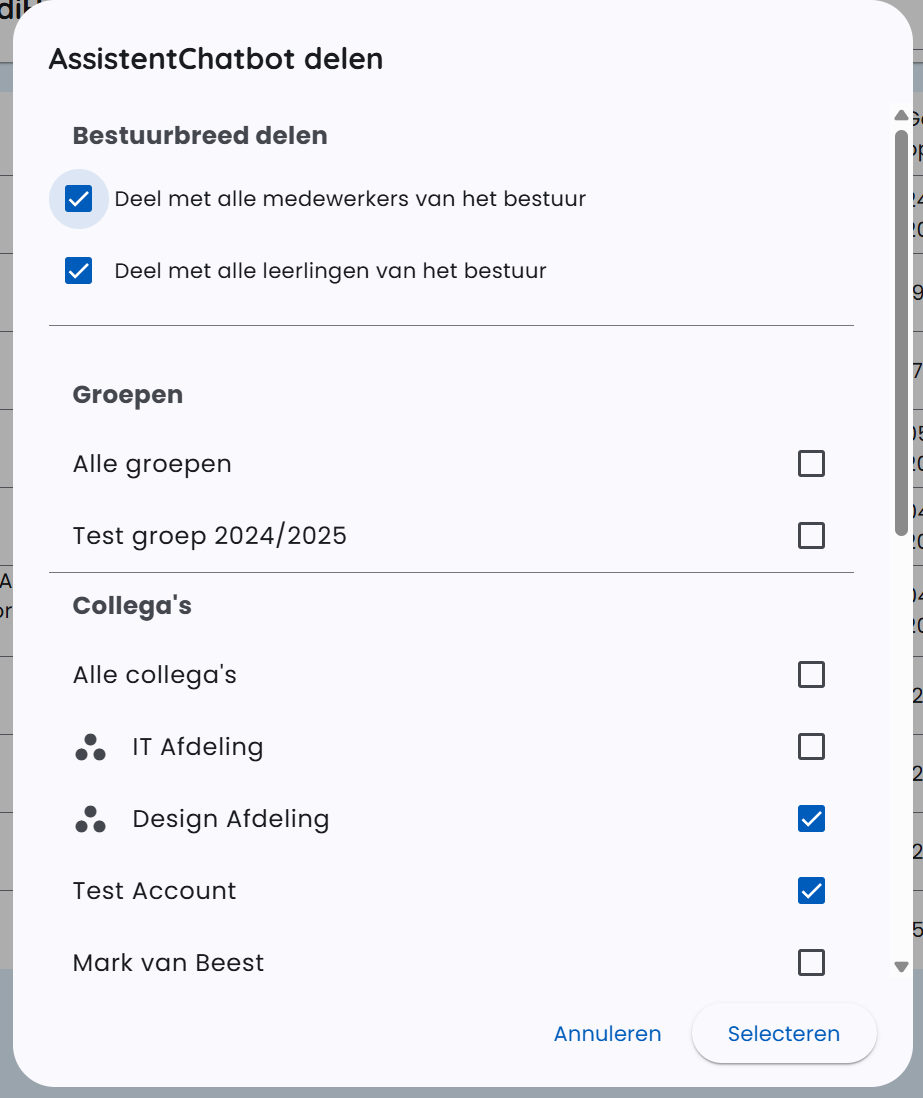
Sharing across the entire board is especially useful for assistants that all staff can use, such as an assistant for lesson preparation or for Dutch language. This way, you do not have to manually select each group and staff member.
Assistant status
Assistants can have two statuses:
- Draft - The assistant is still in development and only visible to the creator
- Visible - The assistant is published and can be shared with others
For assistants you manage, such as your own assistants and school and board assistants, you can change the status. For a colleague’s public assistant, you can only view the status. The creator retains control over the status.